




20 giugno 2011 Domingo de la Calzada S.to Belorado Km.22
BELORADO
Camino Santiago Hostel A Redona s / n.
Belorado (Burgos)
677 811 847 / 947 562 164
Belorado Refuge Parish
Barrio El Corro s / n
Belorado (Burgos) 58 00 85 947
Lucerne
C / Hipólito López Bernal, 10
Belorado (Burgos )
696 427 707 / 947 58 05 91 Albergue de
Mayor Pilgrim Caminante 36
Belorado (Burgos)
656 873 927
privado Albergue El Corro
C / Mayor, 68
Belorado (Burgos)
670 691 173 / 947 580 683
A Belorado pilgrims can drink like its ancient predecessors of the medieval fountain, and pray in the hermit of Our Lady of Belen (Our Lady of the Nativity), was once a hotel. Also shows his parish church of Santa María-rebuilt in the sixteenth century on the ancient church of Our Lady of the Chapel, contains interesting tombs, a chapel of the Camino de Santiago and a beautiful altar-Renaissance, the church of San Pedro, the XVII century and the Convent of the Virgin Bretonera.
In the valley of the Rio Tiron, at the foot of a hill on which are the ruins of a castle built to guard the borders of the country grew thanks to castigliani.Il fueros promulgated by King Alfonso the Ia outside the ancient walls lies the iglesia de Santa Maria (XVI sec.) maintains that a Renaissance altarpiece on which is depicted as a pilgrim and Santiago Matamoros. The iglesia de San Pedro,
overlooking Plaza Mayor, is the seventeenth century; oldest is the San Nicolas church.
June 21, 2011 Belorado San Juan de Ortega Km.24
SAN JUAN DE ORTEGA
Albergue San Juan de OrtegaSan Juan de Ortega (Burgos) 56 04 38 947
- Parroquia San Juan de Ortega
San Juan de Ortega, a small town with 29 inhabitants, from the sea to an altitude of 1000 m. The refuge is located in the great monastery which was once inhabited by the Benedictine Rule 1138 seconds, and then from 1431, was entrusted to the monks of St. Jerome. Sai pay 5 €, is six o'clock Mass, after Mass, the blessing of the pilgrims, after dinner, there is the tradition, started by former parish priest, Don José Maria, to serve the soup of garlic. The Shrine of San Juan de Ortega is located away from roads, in an environment still incontaminato.Era a goal of great importance for pilgrims to Santiago de Compostela, who find shelter and assistance in many hospital dedicated to the saint. If San Domingo de la Calzada is the patron saint of road engineers, San Juan de Ortega (1080 1163), his disciple in
construction of roads and bridges on the way compostellana, it is of surveyors and engineers technical
Inside the church, built from the twelfth century. is the tomb in Gothic (XV century) in which lie the remains of the saint. Capilla de San Nicolas de Bari founded by San Juan to fulfill a vow, is the oldest building of the sanctuary during the spring and autumn equinoxes (March 21 September 21) a ray of light penetrates and illuminates the church in the capital of the Annunciation, one of the most beautiful sanctuary
San Juan de Ortega and the ray of sunshine equinox. On 21 March and 21 September each year at the spring and autumn equinoxes, when day and night (symbol of good and bad) the last time, in the capitals of the church there is a curious phenomenon that can not be considered random. As the sun sets at 5 "de la late" (evening) and for a duration of 10 minutes, a ray of sun light goes to the bas-reliefs depicting a capital in sequence of the Annunciation, the Nativity, Epiphany and the announcement to the shepherds, Jesus appears to the Virgin instead of watching the angel of the annunciation as would be natural, directing his gaze, just to the sunshine. It is an unforgettable and spectacular play of light, certainly wanted, designed and not random, combining astronomical phenomena to mystical visions. It 'something that is often repeated in the architecture of a particular time in the world so-called "pagan". Unequivocal sign of attention to the phenomena "heaven", which marks the passing of time from year to year and from season to season.
June 22, 2011 San Juan de Ortega Burgos BURGOS Km.29
Albergue Municipal de Burgos C / Fernán González, 2
tel: 947 460 922
Burgos - council
Emmaus Pilgrims House
C / San Pedro de Cardena, annex the parish of St. Joseph the Worker
Burgos - Diocese of Burgo
Divina Pastora
Hostel C / Lain Calvo, 10
tel: 947 20 79 52
Burgos - Association of traders
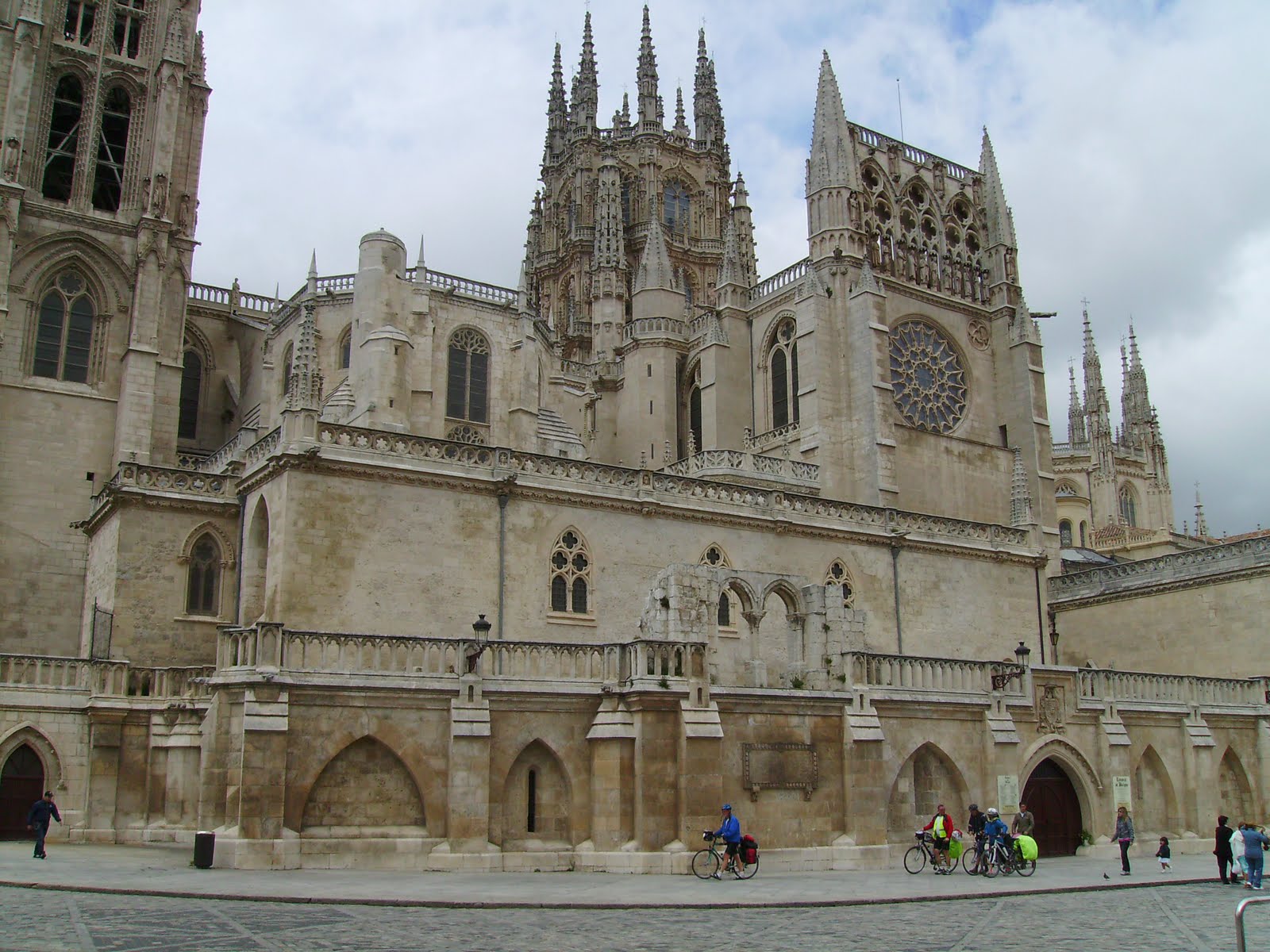
La Cattedrale
Questo fu iniziato nel capolavoro 1221 almost complete and its construction was done in about 40 years. The only exception are the two twin peaks, a profusion of lavish ornamentation and elaborate details, 84 meters high and surrounded by a myriad of pinnacles that were added in the fifteenth century. La Puerta del Sarmental, on the southern facade, is undoubtedly the most beautiful of the portals along the Puerta de la coroner, on the northern side, where it appears the figure of Christ surrounded by the evangelists. Inside are lots of things to admire: the magnificent high altar, a masterpiece overflowing with golden ornaments and decorations, through the Chapel of the Blessed Christ, which keeps a venerated crucifix of the thirteenth century, to the cloister and the tombs medieval carved stone. At the Cathedral of Burgos then tied the story of the hero of one of the most famous legends in English history, is buried under the church in fact the legendary El Cid, hero of the Christian reconquest of Spain.
The city and the Castle
Besides the Cathedral, Burgos is also another, is a compact city, elegant, with lovely walks, streets closed to traffic, good food and friendly atmosphere. Then climb up to the Parque del Castello, where you expect the fortifications of Castello de Burgos, dating from the ninth century but now rebuilt, which was the protagonist of turbulent
EL CID EL CID CAMPEADOR
Campeador is the title given to the knight Rodrigo Díaz de Vivar, who was born in Burgos
(Castile) in 1043, the most popular national heroes of Spain. The title of Campendor was given by Christian soldiers, served under Don Sancho of Castile against the King of Navarre.
the Moors were, instead, called El Cid, when he fought against them, under Alfonso VI of Leon. At
inspired by his exploits: the youth drama The deeds of the Cid
de Guillén de Castro (1618), the famous tragedy of P. Corneille (1636). The Cid, and the masterpiece of heroic poetry of the English Middle Ages, the first half of the twelfth century, entitled The Cantar de Cid The plot of a literary work is as follows: Rodrigo sample by a courtier of the king accused of having embezzled some of the taxes due to the crown, the Moors of Andalusia to Alfonso VI of Leon, and sent into exile.
During his wanderings, passing from Burgos to leave his wife Jimena with his two daughters to the monastery of Cardena.
Many riders join him in fighting the Moors that defeat on several occasions. He captured the Count of Barcelona Valencia wins and defeats the king of Seville, sending new gifts AA Alfonso VI, who
finally allows her family to join him in Valencia The hero is at the height of his fame. The two accounts Carrión seek and obtain from the king the hand of Elvira and Sol, the beautiful and wealthy daughter of Rodrigo de Vivar, but soon the two
reveal all their cowardice on the battlefield. To avenge the humiliation, they move away from Valencia with their wives and, having reached the oak wood of Corpes, lashes and leave them.
The Cid asks Justice to the king, his men compete and win accounts Carrión, who are declared traitors. The poem ends with the remarriage of the daughters of El Cid. Rodrigo de Vivar is brave, loyal and generous, not a great hero like the "Chanson of Roland," has nothing superhuman, or a magic sword that increases its value.
He is just a remarkable man, wise, strong and thoughtful, who lives and works in a context of
linear beauty and virtue is not idealized. He died fighting in 1099 at the age of 56 years.
June 23, 2011
Burgos Hontanas Km.31
Hontanas
Mesón El Albergue Puntido
Calle La Iglesia, 6
Hontanas
tel: 947 37 85 97
Albergue de Hontanas
Calle Real, n º 26
Hontanas
tel: 947377436 - Ayuntamiento
tel: 947377021 - Albergue.
Albergue Santa Brigida
C / Real, 15
Hontanas
tel: 609164697 / 628 927 317
- Private
Hontanas is a town of 65 inhabitants located in the English autonomous community of Castile and Leon Hontanas A small remote country houses with low brick and mud, the scenery is very reminiscent of Sergio Leone westerns
Hontanas June 24, 2011 Boadilla del Camino Km.28, 5
Boadilla del Camino Carrion de los Condes Km.24, 6
Carrion de los Condes Carrión de los Condes
is a town of 2,302 inhabitants located in the English autonomous community of Castile and Leon, comarca of Tierra de Campos, 40 km from Palencia, the capital of the province to which it belongs, 80 km and 95 km from Burgos to Valladolid is that of a lion. It is situated on a hill on the left bank of the river Carrión on one side and dominates the arid Castilian Meseta, flat, fertile plain of the river on the other Carrión. It was during the Middle Ages an important stage of the Camino de Santiago. By that time kept many Romanesque and Gothic. Today is a rural town whose inhabitants are dedicated mainly to agriculture and pastoralism, and there are some small manufacturing industries. Carrion de los Condes
Fitero Km.24 Puente, 6
PUENTE Fiter
The Confraternity of St. James of Perugia manages the Hospital de San Nicolás de Puente Fitero restored by the brothers themselves and open to pilgrims along the Way. Located between Castrojeriz Frómista and is open from June to October. The Hospitaleros belong to the Brotherhood and receive the pilgrims with the ritual washing of the feet and take care of their assistance.
Itero de Castello (Burgos): The Hospital of St. Nicholas de Puente Fitero, located near Pisuerga a bridge over the river, has been renovated into a hostel for pilgrims by the Confraternity of St. James of Compostela in Perugia, in close collaboration with the English Association of the Order of Malta. The Order continues to work with the Brotherhood through CISOM (Italian Ambulance Corps of the Sovereign Military Order of Malta), whose volunteers will be active 23 to 30 May and from 26 July to 8 August (the hostel, excellent volunteers from other organizations, will be open from early May to mid October). For more information, see www.Confraternitadisanjacopo.it.


